Annual
Report
2025
A decade and more of work: school fees, tuition and sports support, scholarships, digital learning, medical assistance — and funding for seventeen organisations across Chennai.
The year in brief
KarmaCorps has been committed for more than a decade to the holistic welfare of children admitted under the Right to Education Act and other deserving students, working closely with families, schools and communities.
During the year, students were supported through school fee assistance, monthly tuition and sports fees, annual scholarships, the library, the computer lab, digital learning and the laptop support programme.
Wellbeing was carried by the things around the academics: home visits, parents' meetings, child protection monitoring, documentary screenings, holiday activities, life-skills sessions, birthday celebrations, sports exposure and student outings.
Medical assistance was extended to students and, where necessary, to the earning parent of a family. Alongside its own programmes, KarmaCorps funded seventeen non-profits working in health, mental wellbeing, education, empowerment, community development and agriculture.
School fees for 46 students
Monthly tuition and sports fees, 98 children
Annual scholarships, 98 children
Tuition centres visited, covering 96 students
Documentaries screened across 48 weeks
Home visits to families
Digital learning · Laptop rental · School fee support · Monthly tuition & sports coaching assistance · Annual scholarships · Birthday celebrations & gifts · Documentary screenings · Student engagement & recreation · Library access · Support to non-profits · Indoor games, arts & crafts · Medical assistance for the needy
The year at a glance
98 children supported · fees for 49 students · 17 partner non-profits · ₹1,14,85,395 invested
| Programme | What happened | Figure |
|---|---|---|
| Tuition and sports | A fixed amount transferred monthly into each child's own account for tuition fees and sports coaching — ₹17,04,000 at Chetpet and ₹3,64,000 at Ayanavaram. | ₹20,68,000 |
| School and college fees | Fees paid for 27 continuing students, 11 new class 10 students, eight from the general category and three transgender students in college. | ₹20,58,499 |
| Scholarships | Allocated on attendance, Saturday participation and academic performance at a meeting on 26 July. | ₹10,06,500 |
| Monitoring | Tuition centres visited two or three times a month, and home visits made to collect mark sheets and address health, attendance and behaviour with parents. | 42 centres |
| Digital learning | The laptop programme grew to 24 students with hard drives added to existing machines; 26 of 28 IXL users practised regularly, mastering 2,701 skills between them. | 3,221 skills |
| Medical assistance | Treatment funded for a child with epilepsy, an accident case, a blood condition, a tonsillectomy, and one family's earning parent. | ₹1,87,200 |
| Saturdays | Screenings ran in 48 of 52 weeks with about 45 children each time, alongside the library, monthly birthdays, Mango Day and a chess and carrom competition. | 75 films |
| The picnic | A day at MGM Dizzee World with volunteers assigned 12 to 15 children each, ID cards for every participant and a first aid kit travelling with the group. | 106 on trip |
| Community support | Monthly funding for organisations in health, mental wellbeing, education, empowerment, community development and agriculture, with the work monitored and reviewed. | ₹41,86,000 |
| Total invested | Partner support, tuition and sports fees, school fees, salaries, scholarships, devices, medical assistance and student activities, 2025. | ₹1,14,85,395 |
Attendance and academic progress
Attendance at the tuition centres was recorded daily and reviewed periodically through the year — the simplest early warning we have that something at home or at school has gone wrong.
67.5% of students held 90–100% attendance — strong participation, held up by monitoring and follow-up.
Attendance here is more irregular. This group needs intensified monitoring, parent engagement and early intervention.
Annual scholastic progress — 107 students
This review is based on mark sheets collected from the schools; no independent examination was conducted. Most students sit in the 30–49% band, followed by 50–59% and 60–69%. Scores above 70% were limited, and a smaller group fell below 30%. The honest reading is average performance with identifiable learning gaps — mid-range scores dominate, and both extremes are thin.
Class 10 is the concern: concentration in 30–49% and 20–29%, which at board level needs close monitoring. Among new entrants the spread runs from 30–49% to 60–69%, with one student in 90–100% — clear potential in the group.
Keeping 46 children in their classrooms
We pay school fees so that deserving students can continue their education with stability and dignity — some under our full support programme, others on an annual fee-only basis.
| Programme | Students | Amount |
|---|---|---|
| School fees — continuing KC students, classes 6 to 10 | 27 | 13,31,430 |
| School fees — new class 10 students | 11 | 4,37,684 |
| School fees — general category | 8 | 2,50,885 |
| College fees — transgender students | 3 | 38,500 |
| Total | 49 | ₹20,58,499 |
Allocated on attendance, participation in the Saturday programme and academic performance. At Chetpet, 39 students received ₹11,000, 17 received ₹12,000 and 22 received ₹8,500 — ₹8,30,000 in all. At Ayanavaram the spread was more even across slabs, totalling ₹1,76,500.
Monthly tuition and sports fees. A fixed amount was transferred every month into each child's own bank account for tuition fees and sports coaching — ₹17,04,000 across 80 children at Chetpet and ₹3,64,000 across 18 at Ayanavaram. Direct transfer keeps it transparent, accountable and on time.
Sicgil India. Eight students shortlisted on academic performance and economic background shared a sponsored scholarship of ₹50,000. A thank-you letter was sent to the sponsor.
Family financial assistance. Direct monthly support to one family continued through the first quarter of the year.
When health interrupts school
Support was extended to students and their families facing health problems, so that treatment did not cost a child their education. Five beneficiaries were helped, with ₹87,200 disbursed for students' own treatment and further support alongside.
| Case | Support given |
|---|---|
| Child with epilepsy | Ongoing medical treatment |
| Accident case | Hospitalisation and rehabilitation |
| Blood-related condition | Treatment support |
| Severe tonsillitis | Surgery and hospitalisation |
| Parent of a student | Treatment support for the family's earning member |
Home visits and meetings
Fifty-two home visits were made through the year — to collect mark sheets, track attendance, address health and behavioural issues, and talk to parents on their own ground. Attendance and behaviour both improved where the visits happened, and so did parental involvement.
Forty-two tuition centres were visited, two or three times a month each, covering 96 students, with student behaviour and centre operations observed on every visit. Regular meetings with staff, parents and students kept decisions recorded and followed up.
Laptops, IXL and what the data says
The laptop programme, four years old this year, began with 18 students; from August a further six were added, taking it to 24. Additional laptops were purchased and hard drives installed in existing machines to improve storage and performance — ₹3,08,855 in all.
The usage data is not flattering and we publish it as it is. Against 8,760 hours available in the year, most students recorded under 70 hours — less than 2% of the time the device sat with them. Among the six new users over five months, only one approached the expected minimum.
Ten review meetings were held on device usage. Our reading of the cause: low motivation, academic fatigue, and a lack of confidence rather than a lack of access. Usage should improve with clear goals, activities worth opening the laptop for, parental support, and children taking responsibility themselves.
On IXL, 26 of 28 children practised regularly through the year. Together they practised 3,221 skills, reached proficiency in 2,783 and fully mastered 2,701. The top performer of 2025 achieved 534 skills.
IXL skills practised
Skills fully mastered
Laptops with students
Device review meetings
Despite sustained IXL use, grade-level outcomes remain limited: foundational gaps, unclear concepts, language and confidence barriers, and fatigue mean children complete skills without mastering them. With structured guidance and targeted practice, the platform still does its job — the alignment between teaching, guided practice and grade-appropriate skill selection is what needs work.
Documentaries, mangoes and medals
Documentary screenings. Out of 52 weeks, screenings ran in 48 — 75 documentaries in all, on topics well outside the syllabus. Average attendance was 45 children, with a maximum of 60 and a minimum of 38. They build general awareness, critical thinking and curiosity, which is most of what school does not have time for.
Library. The child-friendly library was maintained through the year with textbooks, storybooks, reference works and general knowledge titles, and book usage recorded in the register.
Birthdays. Held in the last week of every month for all children with birthdays that month — decorations, cake, gifts and a room full of people paying attention to them.
Mango Day, 28 June. Sixty students attended on the day and the rest received theirs the following week: a packet of six mangoes each for 80 children, a short film on why they are good for you, and everyone asked to wear yellow. Staff got mangoes too.
Chess and carrom. Twenty students played over several days, with finals on the last day. All twenty received cups; first, second and third prizes were awarded in both games. Patience, discipline, and learning how to lose.
Toy drive. Our children collected 125 toys, play items, water bottles and lunch boxes for children affected by cancer, for a drive organised by TIARA — 101 students took part.
Snacks — samosas, cake, sandwiches — and clean drinking water were served at events and long sessions, to keep energy and attention up and to make the room a welcoming one.
MGM Dizzee World, 6 September
One hundred and six children and staff spent the day at MGM Dizzee World. Transport, food and entry tickets were arranged in advance, at a cost of about ₹1,23,000.
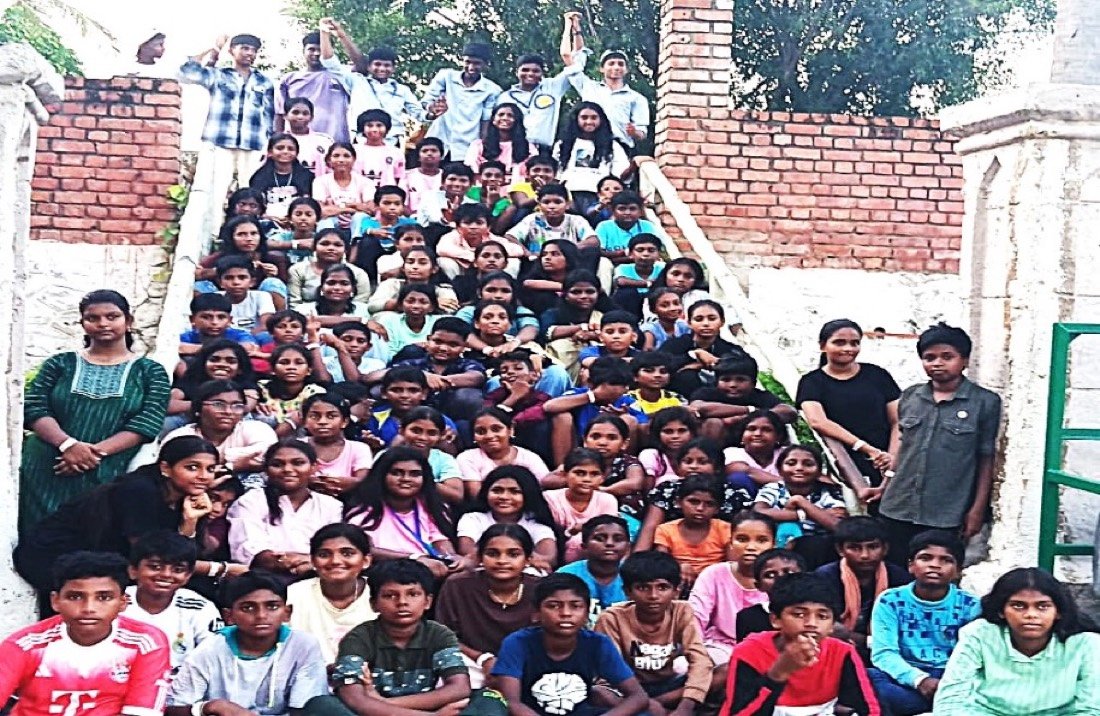
Care was organised, not assumed. Volunteers — our Care Champions — were assigned 12 to 15 children each and stayed with them through travel, rides, meals and activities. Every participant wore an ID card, a first aid kit travelled with the group, and heights were checked in advance so ticketing was right before anyone queued.
The children took the water rides and the car racing, and performed dances on the stage. Lunch was chicken biryani, egg, water and ice cream; our founder joined the group with his family for it.
The day closed between 7 and 7.30 p.m. and every child went home safely — a well-managed outing, and by the evidence of the photographs, a genuinely happy one.
Records, registers and compliance
Manual registers are the official record for every initiative; the same data is kept digitally, organised initiative by initiative. The dual system keeps information safe, current and easy to verify.
Receipts and vouchers
Bills, vouchers, monthly signature sheets and acknowledgement notes collected and verified against expenditure — for accountability, transparency and audit readiness.
Activity records
Daily activities, tuition attendance, cleaning, Saturday programmes, library usage, screenings, birthdays, laptop rentals, scholarships, staff and fees — plus student files for 98 children and data on 42 centre teachers.
Asset register
Laptops and accessories tracked by allocation, usage and maintenance, so devices cannot quietly go missing.
Partner due diligence
Due diligence and information on all 17 partner non-profits stored digitally, strengthening compliance and partnership credibility.
Academic review
Progress reviewed two or three times a year; IXL, laptop usage and other platforms monitored to identify where digital learning is not being taken up.
Socio-economic data
Family, education, occupation and address details maintained and updated, alongside the device inventory and student information.
Seventeen organisations, ₹41,86,000
We support non-profits working in health, mental and physical wellbeing, youth welfare, transgender support, cancer care, rehabilitation, education, community development and agriculture. Support goes beyond funding: we monitor and review the work, and additional assistance is released during the year where a specific need arises.
Partner organisations
Committed every month
Total for the year
Areas funded this year include youth and children's leadership and empowerment; education, scholarships and IT; rural and urban children's education; welfare of the visually challenged; medical support for cancer and haemophilia; transgender welfare and rehabilitation; elder care; support for children with disabilities; community development and agriculture. Additional grants covered a fridge, school needs and medical costs at partner organisations.
₹1,14,85,395 for the year
Expenditure is reported by programme rather than by month, with receipts, bills, vouchers and signed acknowledgements behind each line. Most of the money goes where it should: education support, student welfare and the partner organisations.
Programme-wise expenditure
Figures in rupees. Bar lengths are relative to the largest programme. One crore fourteen lakh eighty-five thousand three hundred and ninety-five.
Within these totals: tuition and sports fees split ₹17,04,000 at Chetpet and ₹3,64,000 at Ayanavaram; scholarships ₹8,30,000 and ₹1,76,500 respectively; ₹3,08,855 on laptop purchases and hard drive installation; ₹1,80,000 rent and ₹14,277 electricity at Chetpet; and ₹2,00,000 in additional partner support for medical costs, a fridge and school needs.
What 2025 leaves behind, and what next
This year's programmes — tuition support, scholarships, school fee assistance, the laptop rental programme, the computer lab, the library and the Saturday screenings — ran alongside support for over seventeen non-profits working in mental, physical, visual, educational, community, sports and digital development.
The areas we have identified for ourselves are specific: continuous academic monitoring, greater parental involvement, more digital learning resources, structured career guidance for senior students, stronger child protection practice, and more individual support for academically weaker children.
Two numbers in this report are uncomfortable — laptop usage and class 10 marks — and they are printed here on purpose. They are where next year's work goes.
With sustained commitment and focused improvement, these initiatives will keep doing what they were built to do: give children a fair chance at a secure and successful future.